Getting the keys does not end a promoter’s responsibility for a flat. Under the Real Estate (Regulation and Development) Act, 2016, defects that surface in the first five years are the promoter’s to repair, free of charge. Most buyers know the five-year figure. Fewer know how the clock runs, what a useful notice looks like, or what MahaRERA does when a promoter ignores one.
None of this applies to Codename Vybe yet. The project is at pre-launch, MahaRERA has not yet issued it a registration number, and no possession date has been announced. This guide is for later, and for reading the defect clause of the agreement for sale when it arrives.
What Section 14(3) actually says
The wording, as published in the Gazette of India on 26 March 2016, is worth reading in full:
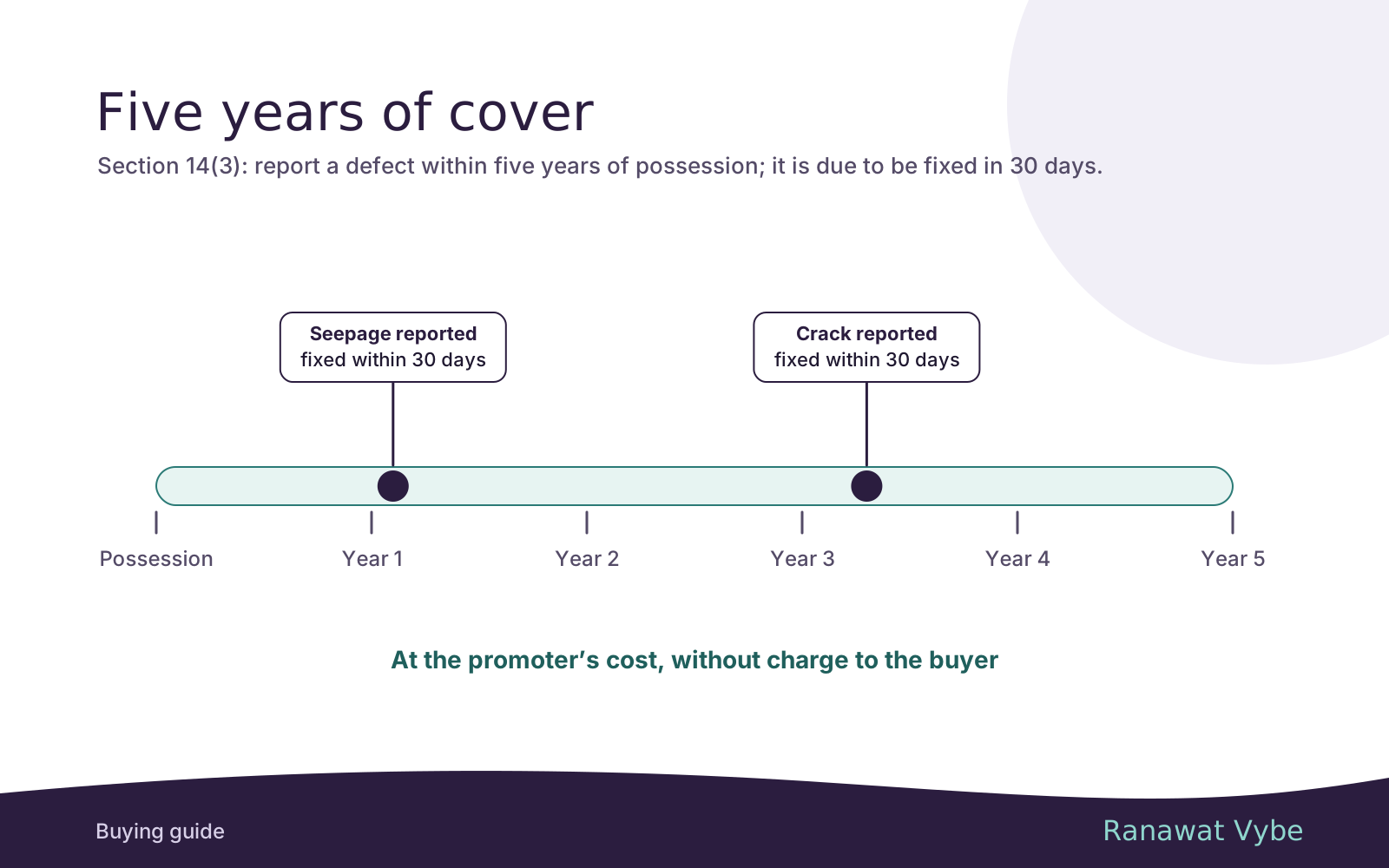
In case any structural defect or any other defect in workmanship, quality or provision of services or any other obligations of the promoter as per the agreement for sale relating to such development is brought to the notice of the promoter within a period of five years by the allottee from the date of handing over possession, it shall be the duty of the promoter to rectify such defects without further charge, within thirty days, and in the event of promoter’s failure to rectify such defects within such time, the aggrieved allottees shall be entitled to receive appropriate compensation in the manner as provided under this Act.
Three details matter in practice. The five years run from the date possession is handed over, not from the occupancy certificate or the date of the agreement. What has to happen inside the five years is the notice: the defect must be brought to the promoter’s attention within that window. And the duty outlives the conveyance. A proviso to Section 11(4)(a) says the promoter’s responsibility for these defects continues even after the conveyance deeds for all the flats have been executed.
What counts as a defect
The Act does not publish a list. Its wording reaches structural defects, poor workmanship and quality, the services provided, and anything else the promoter promised in the agreement for sale. Recent MahaRERA orders show the kinds of complaints that succeed:
| Case, as reported | Defects | What MahaRERA directed |
|---|---|---|
| Godrej 24, Hinjawadi, Pune: order of 2 January 2026, reported by LiveLaw in January 2026 | Recurring seepage in a living room that earlier repainting had not cured | A permanent repair at the promoter’s cost within 30 days, with penal action if it was not done |
| Mandor Heights, Borivali, Mumbai: reported by the Free Press Journal in March 2026 | Wall cracks, seepage and ceiling leakage in flats handed over in December 2020 | Full repairs at the promoter’s cost within 30 days, with the buyers giving access |
| 41 Elite, Tathawade, Pune: order of 2 April 2026, reported by GeoSquare in April 2026 | Ceiling seepage, wall cracks, a badly sloped balcony and faulty plumbing | All structural and workmanship defects fixed within 30 days |
The Borivali case also shows where promoters push back. The developer blamed poor maintenance and the owners’ own alterations, and argued that its liability lasted only three years. MahaRERA rejected both arguments: the five years applied, and the developer had produced no expert report to answer the buyers’ structural inspection, which traced the problems to terrace seepage and failed waterproofing. A bare denial without evidence, it found, could not answer the buyers’ case.
The lesson cuts both ways. Evidence wins these disputes, and interior work that cuts into waterproofing or structure hands a promoter an argument you would rather it did not have.
How to document and notify a defect
- Start at handover. Walk the flat with a written snag list and dated photographs before you sign the possession letter, and keep a copy signed by the promoter’s representative.
- Record each problem when it appears. Photograph seepage marks, cracks or leaks with the date visible, and note when they get worse, for example after the first heavy rain.
- Write to the promoter. Send an email and a letter by registered post to the address in your agreement. Describe each defect and where it is, cite Section 14(3), and ask for repair within 30 days. Keep the postal receipt and any acknowledgement.
- Get an independent report for anything serious. A structural engineer’s report on cracks or recurring seepage is the kind of evidence that carried the Borivali case.
- Offer access in writing. Propose dates for inspection and repair. A promoter that can say it was kept out has an easier defence.
- Use the society for common areas. In the Godrej 24 order, MahaRERA turned down one buyer’s claim about a common amenity, saying an individual cannot seek group-level relief alone. Route complaints about terraces, lifts and shared services through the society or association, which Section 31 expressly allows to file.
If the promoter does not act
Once 30 days pass without a proper repair, the next step is a complaint to MahaRERA under Section 31, filed online on its portal, which shows the current filing fee. MahaRERA can order the repair, as it did in each case above, and Section 63 lets it penalise a promoter that ignores its orders, by up to five per cent of the project’s estimated cost. In the Borivali order, the buyers were also allowed to carry out the work themselves and claim the cost if the developer failed to comply.
Money compensation runs on a separate track. Section 71 sends compensation claims under Section 14 to an adjudicating officer who is or has been a District Judge, and Section 72 tells that officer to weigh the loss caused, any unfair gain to the promoter and whether the default was repeated.
There is also a voluntary route. MahaRERA’s conciliation forums bring both sides before a conciliator, and The Realty Today reported in October 2024 that the 52 forums had settled 1,749 of the 5,958 cases filed with them since 2018.
What to check for Codename Vybe
When an agreement for sale is issued, check that its defect clause gives the full five years from possession and does not quietly narrow what counts as a defect. Keep the published specifications with your papers too. Once they are written into your agreement, a line such as vitrified tiles on the balconies or a glass shower partition becomes an obligation that Section 14(3) reaches, because the section covers promises in the agreement, not only structure. It is also fair to ask how the developers have handled repairs in their existing projects, which are listed on the developer page.
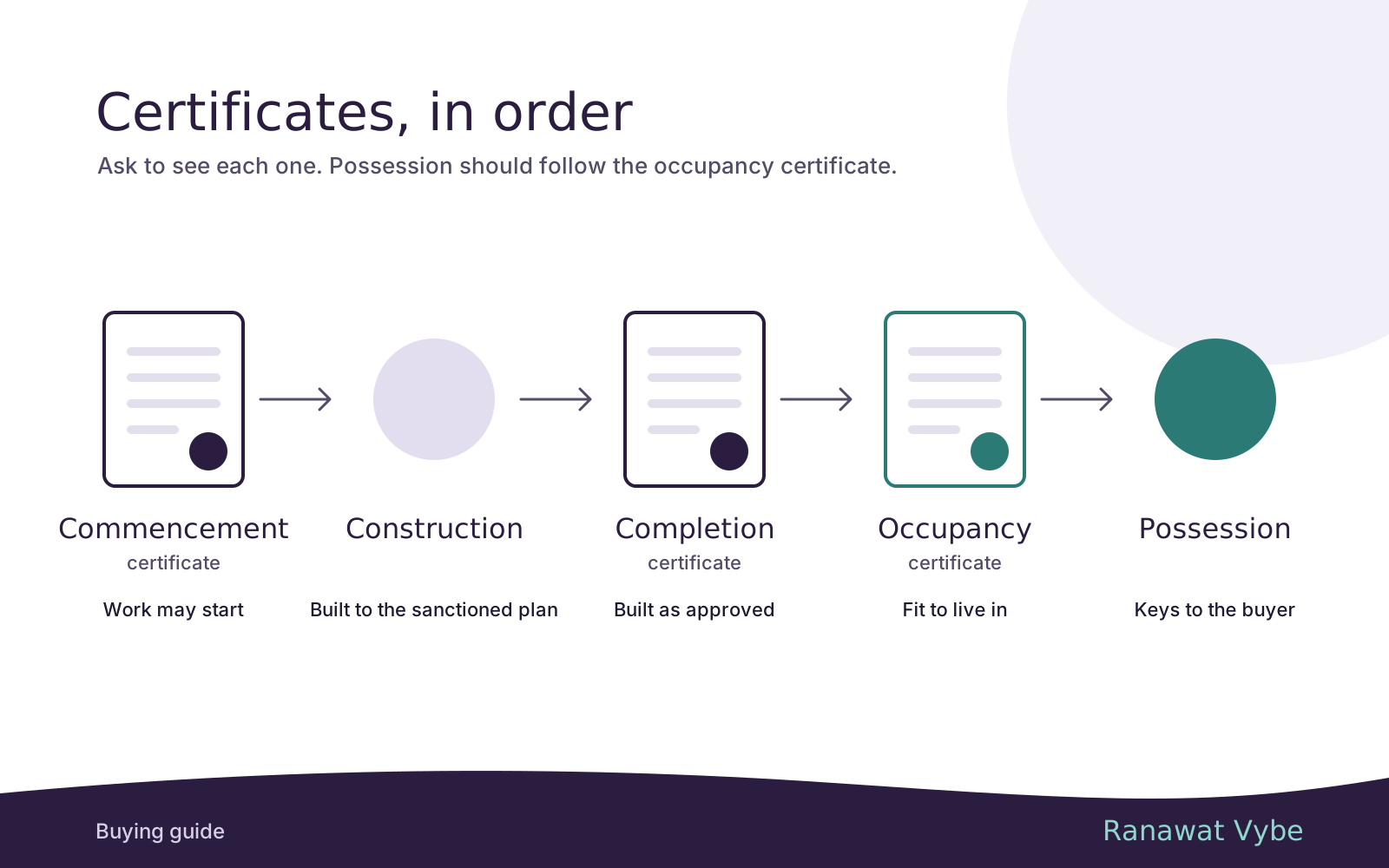
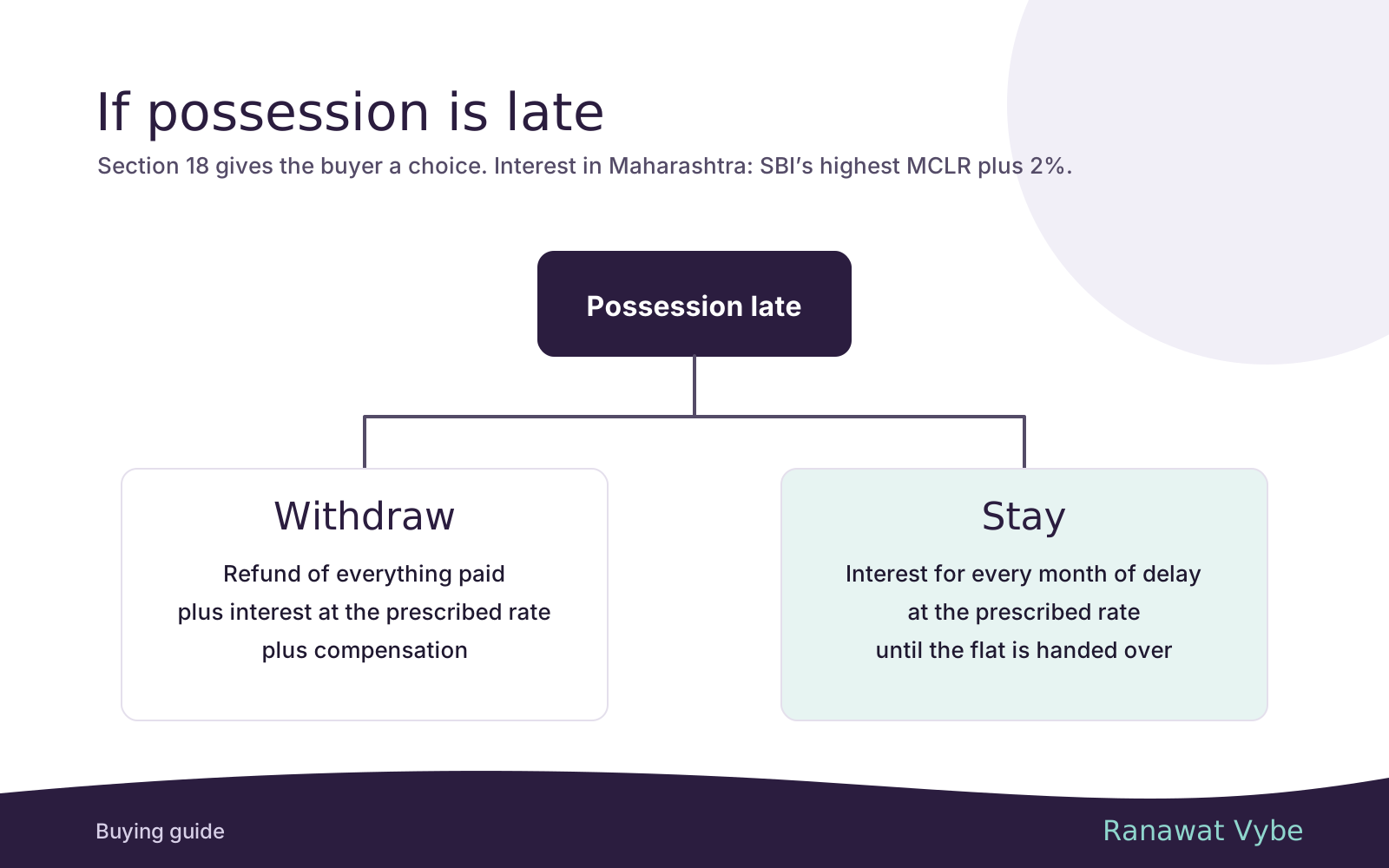
Defect liability begins at possession, and possession should come with an occupancy certificate. The guide to the OC and completion certificate explains why, and the guide to possession delays covers what happens if the date slips. None of this is legal advice; it summarises the Act and recent orders.
If you would like the draft agreement when it is available, you can ask on the contact page.