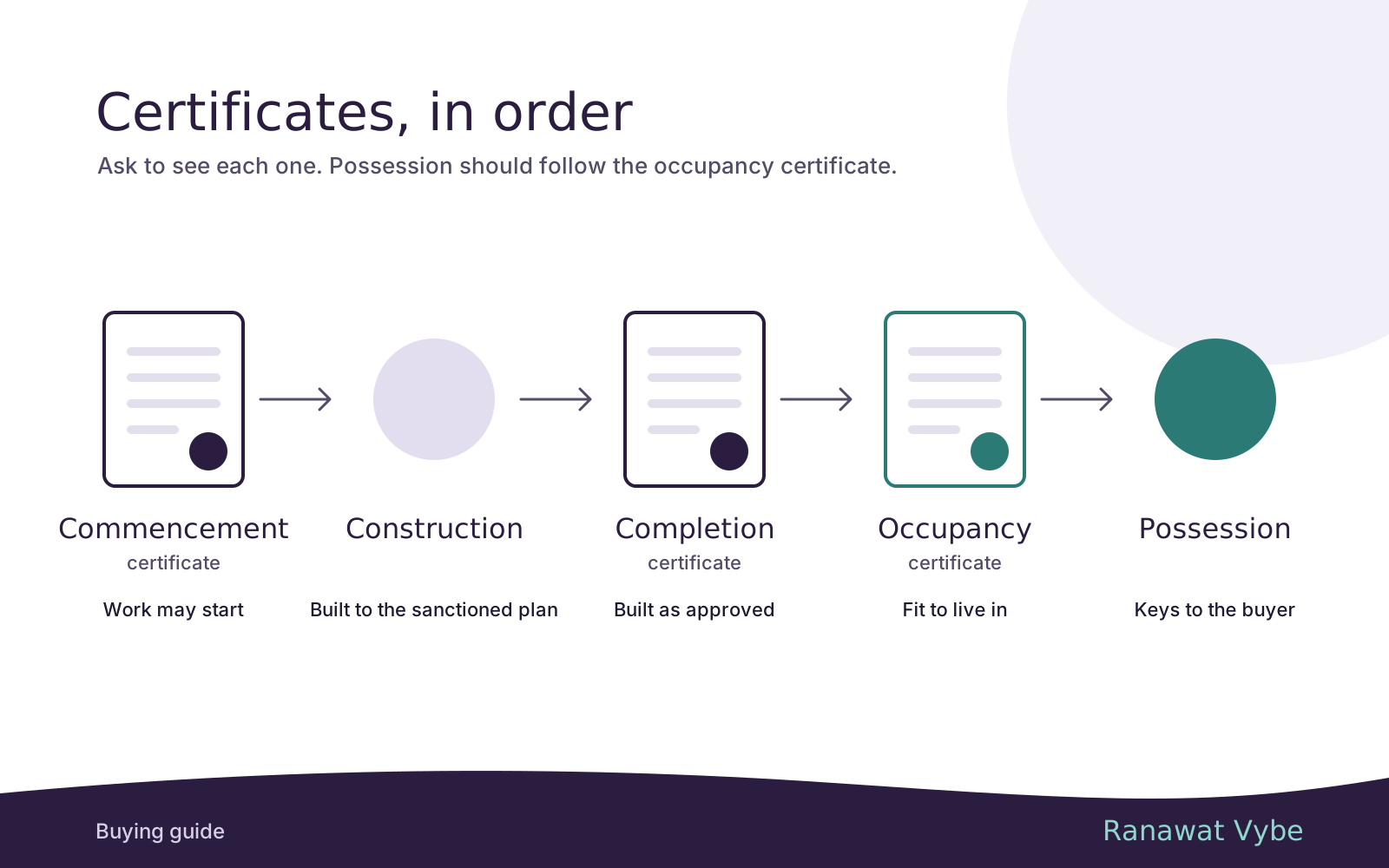
Two certificates arrive at the very end of a building’s construction, and together they decide whether it may lawfully be lived in. The completion certificate says the building was built as sanctioned. The occupancy certificate, or OC, is the planning authority’s permission to occupy it. In Pune, the confusion usually starts with the letters “CC”.
Codename Vybe is a pre-launch project with no MahaRERA registration number or possession date published, so its certificates are years away. What follows is how the system works in Pune Municipal Corporation limits, so you know what to ask for when the time comes.
Two certificates, two different questions
Both are defined in Section 2 of the Real Estate (Regulation and Development) Act, 2016. A completion certificate certifies that a project “has been developed according to the sanctioned plan, layout plan and specifications”. An occupancy certificate permits “occupation of any building” and is tied to civic infrastructure “such as water, sanitation and electricity”. The working detail comes from local rules, which for the PMC are the state’s Unified Development Control and Promotion Regulations, notified on 2 December 2020.
| Question | Completion certificate | Occupancy certificate |
|---|---|---|
| Who produces it | The owner, through the architect or engineer who supervised the work | The planning authority, here the PMC |
| What it says | The building has been completed as per the sanctioned plans | The building may be occupied |
| What goes with it | Plans of the completed building, a lift operation certificate, a structural stability certificate and, for special buildings, the fire officer’s NOC | One set of plans certified by the authority |
| Timing | Filed once construction is finished | Issued or refused within 21 days of the completion certificate, failing which the work is deemed approved if it conforms to the sanctioned plans |
| Rule | Regulation 2.9 | Regulation 2.10 |
Now the “CC” problem. In Maharashtra the same letters are also used for the commencement certificate, the permission to start construction granted under Sections 44 and 45 of the Maharashtra Regional and Town Planning Act, 1966. A commencement certificate tells you building may begin. It says nothing about whether the finished building may be occupied. Whenever someone mentions “the CC”, ask which one they mean.
Why possession without an OC is a poor bargain
The rules are unusually direct. The commencement certificate format in the regulations carries the condition that no building or part of it shall be occupied, or allowed to be occupied, until the occupancy certificate is granted. MOFA, Maharashtra’s older flats law, separately bars a promoter from letting anyone into possession before a required completion certificate is issued. Under RERA, Section 11(4)(b) puts the duty to obtain the certificates on the promoter, and Section 19(10) starts the buyer’s own two-month window to take possession from the date of the OC.
Recent cases show what is at stake:
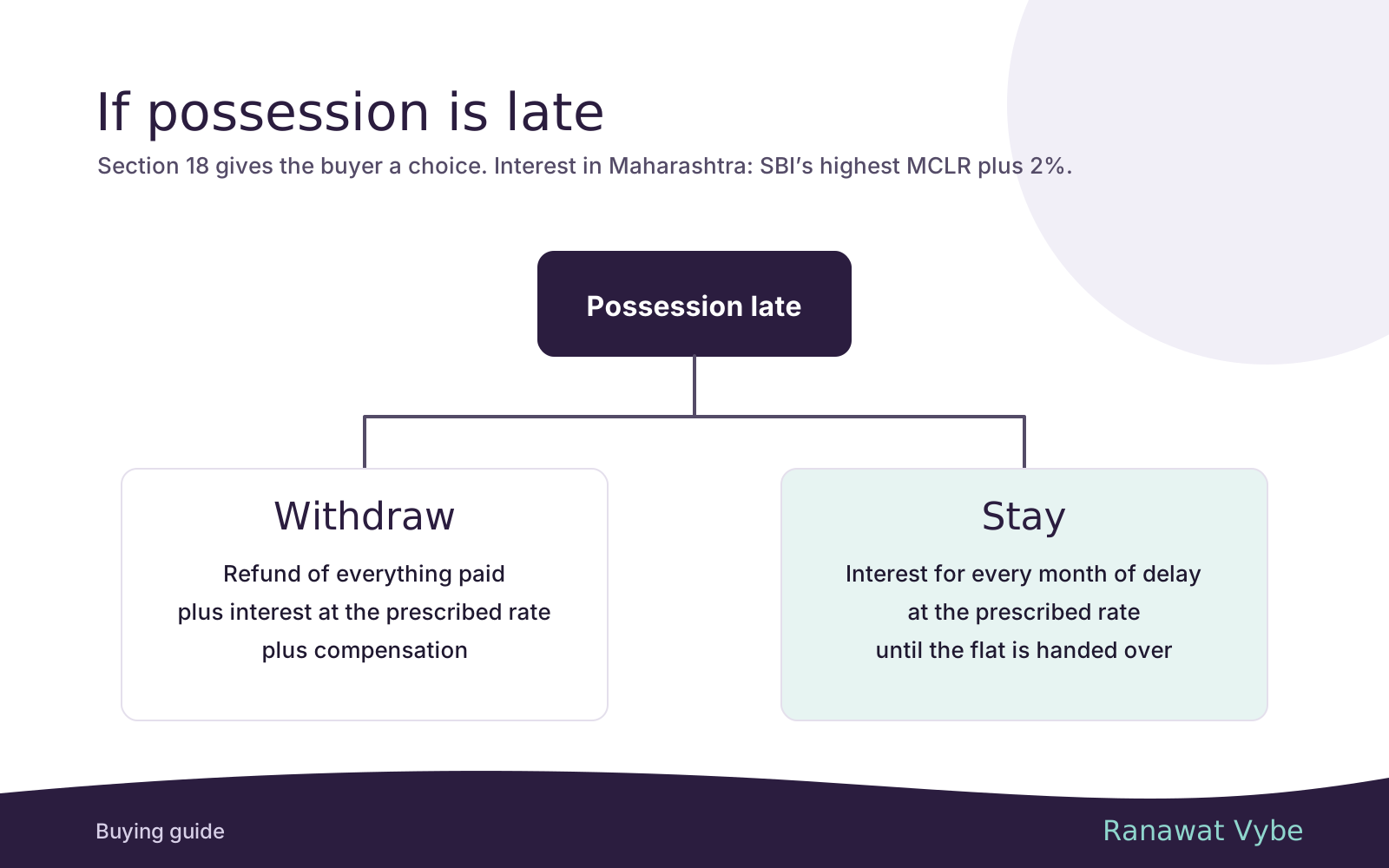
- In December 2025, in a Vasai project, MahaRERA held that “fit-out possession” offered without an OC is not valid possession, so the buyers could not be penalised for refusing it and delay interest kept running until possession with an OC, as Square Feat India reported.
- In January 2026, the PMC’s Hadapsar ward office asked a developer to explain why residents were living in a building without an OC and why penal action should not follow, according to Punekar News. In May 2026 the PMC opened an inquiry into a project in the same locality, where a complainant has asked for triple property tax to be recovered from residents; no decision had been reported.
Moving in early can leave you as the occupant of an unauthorised building, which is a weak position from which to press for anything else.
Part OC: useful, but read what it covers
Regulation 2.11 lets the authority issue a part occupancy certificate for a building, or part of one, before all the work is finished, provided precautions are taken for the safety and health of the occupants and the owner indemnifies the authority. It is how the first wings or floors of a large project get occupied while the rest is built.
A part OC can properly mark handover for the floors it names. In an April 2026 Pune case against Kolte-Patil, reported by GeoSquare, MahaRERA ended a delay-interest period on the date a part OC was received for floors up to the 22nd. But it covers only what it names. GeoSquare also reported in June 2025 that MahaRERA had begun checking about 2,600 OCs uploaded by promoters with the planning authorities, partly because some developers had presented part OCs as full ones. And in an April 2026 order on a Tathawade project, MahaRERA held that an OC does not amount to lawful possession if the flat itself remains structurally defective.
How to check an OC
- Ask for a copy and read which building, wing and floors it covers, and whether it is full or part.
- Look on MahaRERA. Promoters are expected to upload the OC to the project’s page on the MahaRERA portal. Compare that copy with yours, and ask why if it is missing.
- Confirm with the PMC. The building development department can confirm whether a certificate with that number and date was issued.
- Match it to the sanctioned plan. The OC approves the building as sanctioned. If the flat you are offered differs from the approved plans, ask why.
- Ask for the attachments. The structural stability and lift certificates filed with the completion certificate, and the fire NOC where required, should reach the society later in any case.
- Check the services. The OC is tied to water, sanitation and electricity, so confirm that the connections are permanent before you move in.
Where Codename Vybe stands
For now, the documents to watch for come earlier: the MahaRERA registration, and with it the sanctioned plans and the commencement certificate the promoter relies on. The floor plans and specifications on this site are taken from the developer’s working presentation, and the approved versions are what an OC will eventually be measured against. Once possession nears, the guide to possession delays and the guide to defect liability pick up where this one ends. This is general information, not legal advice.
If you would like a note when the registration and approvals appear, you can ask for one on the contact page.