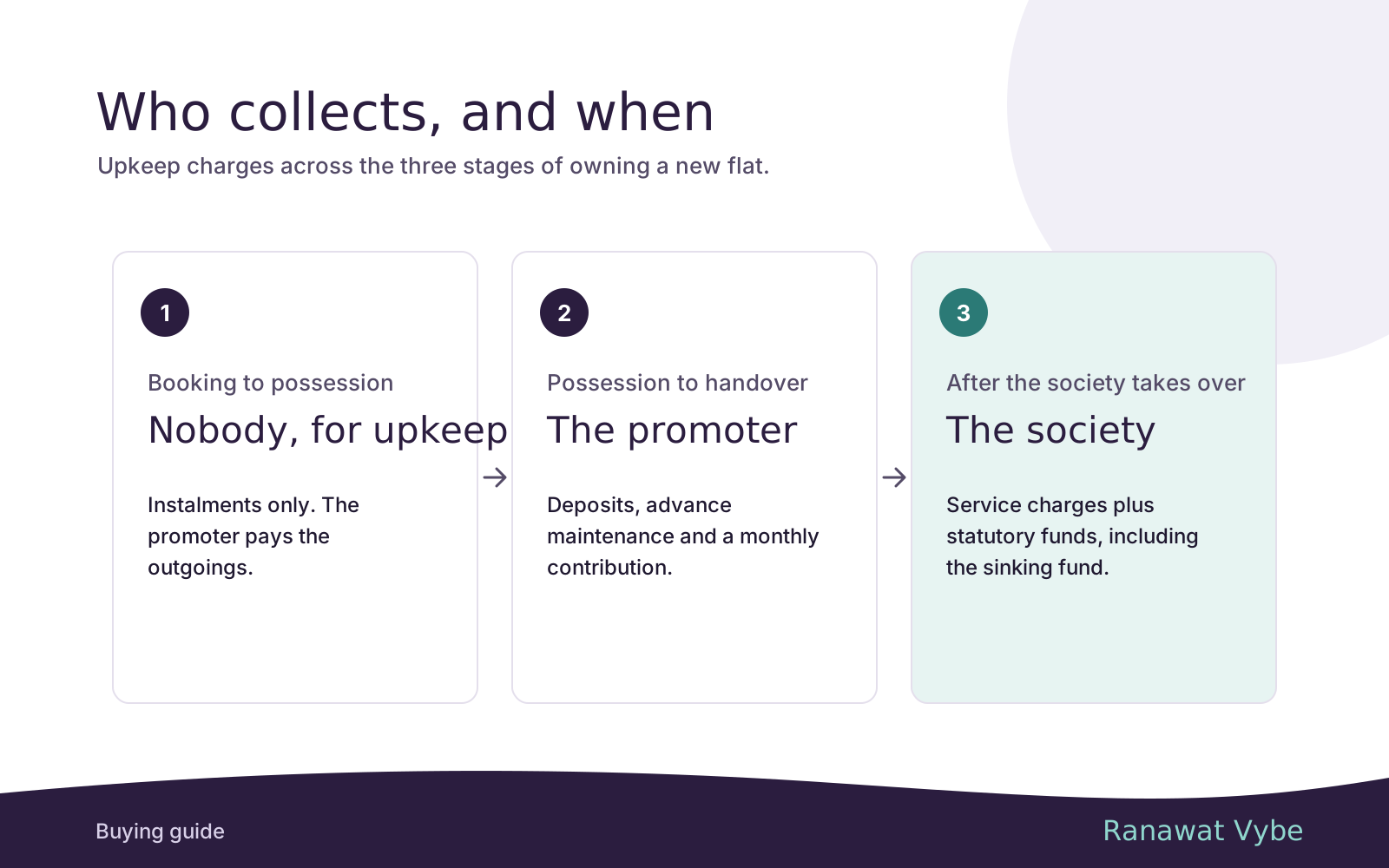
The price list tells you what a flat costs to buy. It rarely tells you what it costs to run. Maintenance in a Maharashtra housing project is paid in three stages, to two different collectors, under rules that changed in June 2026. Knowing which stage you are in tells you who sets the charge and where your money sits.
The three stages
| Stage | Who collects | What you usually pay | Main rule |
|---|---|---|---|
| Booking to possession | Nobody, for upkeep | Instalments only; the promoter pays the outgoings | RERA Section 11(4)(g) |
| Possession to society handover | The promoter | Deposits, advance maintenance, a monthly contribution | Your agreement for sale; RERA Sections 11(4)(d) and 19(6) |
| After the society takes over | The co-operative housing society | Service charges plus contributions to statutory funds | Maharashtra Co-operative Societies Rules, as amended in 2026 |
Before the society forms
The Real Estate (Regulation and Development) Act, 2016 sets the frame. Section 11(4)(g) makes the promoter pay all outgoings until physical possession is transferred, including outgoings it has collected money for. Section 11(4)(d) makes the promoter responsible for providing and maintaining essential services, “on reasonable charges”, until the association of allottees takes over maintenance. Section 19(6) makes you liable for your share of maintenance charges, municipal taxes and similar costs, in the manner your agreement sets out.
The detail, then, is in the agreement. To see what this looks like in practice, we read a draft agreement for sale for a project in Thane in November 2026. It asked the buyer to deposit, before possession:
- share money and the entrance fee for the society;
- a charge for forming and registering the society;
- a proportionate share of the society’s taxes; and
- other charges for development, water and electricity connections, legal work and infrastructure.
It also took a maintenance deposit at possession that earns no interest and stays with the promoter until conveyance, when the balance, after expenses, passes to the society. And it made the buyer liable for outgoings from a deemed possession date a week after the possession notice, whether or not the buyer had moved in. One more line is worth looking for in your own draft: this one said the promoter would not pay maintenance for unsold flats. Ask who covers that share.
How many months of maintenance is collected in advance varies by project and is fixed in the agreement. We could not find a statutory limit on it. The Maharashtra RERA Rules of April 2017 require the promoter to apply to register the society within three months of a majority, 51%, of allottees booking, which is the point at which this stage should begin to end.
The sinking fund and the repair fund
Once the society runs the building, two reserves matter most. The 2014 model bye-laws for co-operative housing societies set minimum contributions, and the Maharashtra Co-operative Societies (Amendment) Rules, 2026, notified on 18 June 2026, carry the same minimums into a new Rule 106C-11, according to TaxGuru in July 2026.
| Fund | Minimum yearly contribution | Used for |
|---|---|---|
| Sinking fund | 0.25% of the construction cost of each flat, excluding land | Heavy repairs, as the general body approves |
| Repair and maintenance fund | 0.75% of the construction cost of each flat | Routine, recurring repairs |
| Major repair fund | As decided, collected on carpet area | Large one-off works |
Construction cost here means the cost certified by the architect when the building was put up, not today’s market value. The general body can set higher rates, not lower ones. As a purely illustrative example, not a figure for any real project: if the certified construction cost of a flat were ₹40 lakh, the minimums would be ₹10,000 a year to the sinking fund and ₹30,000 a year to the repair fund.
The 2026 rules also make an election fund compulsory, allow a voluntary welfare fund and an optional corpus fund, and set an education and training contribution of ₹10 per member per month.
How monthly charges are shared
The same amendment changed how a society may split its bills. According to TaxGuru in July 2026 and a Free Press Journal column the same month:
- Service charges are divided equally among flats, not by area.
- Property tax on common areas and building insurance are shared by carpet area.
- Interest on unpaid dues is capped at 12% simple interest a year. Law firm King Stubb & Kasiva noted in July 2026 that the earlier ceiling was 21%.
- Non-occupancy charges, for a flat that is let out, are limited to 10% of the service charges.
- Parking charges are set by the general body. What you can own in the first place is explained in the article on parking.
GST is a separate question. A Central Board of Indirect Taxes and Customs circular of July 2019 (No. 109/28/2019) says maintenance of up to ₹7,500 per member per month is exempt; above that the whole amount is taxable, not just the excess. A society whose annual turnover is ₹20 lakh or less need not pay GST even above ₹7,500, and an owner of two flats has the limit applied to each flat separately. Check whether those thresholds have changed before you rely on them.
What to ask before you sign
- What is the estimated monthly maintenance, and what does it assume about lifts, security, water and power backup?
- How many months are collected in advance, and is it a deposit or prepaid maintenance?
- Is any sinking fund or corpus collected at possession, and when does it pass to the society?
- Who pays the share for unsold flats?
- From what date does your liability start: the possession notice, a deemed date, or the day you take the keys?
- Will audited accounts of the promoter’s maintenance period be handed to the society?
Running costs follow what a building contains. Codename Vybe’s plans show each lift core with three passenger lifts plus a separate fire lift, and the developer has named a clubhouse, two pools and more than twenty amenities; the floor plans and specifications list what has been published. No maintenance estimate has been released yet.
When it is, we will share it. If you would like it sent to you, leave your details here.