Sinhagad Road runs towards the reservoirs that supply Pune, so it is easy to assume water is the one thing the corridor has in plenty. The reality is patchier. Some older housing gets regular municipal supply; some newer buildings a short distance away depend on tankers every summer. If you are buying here, water deserves the same scrutiny as the floor plan.
Four dams, one system
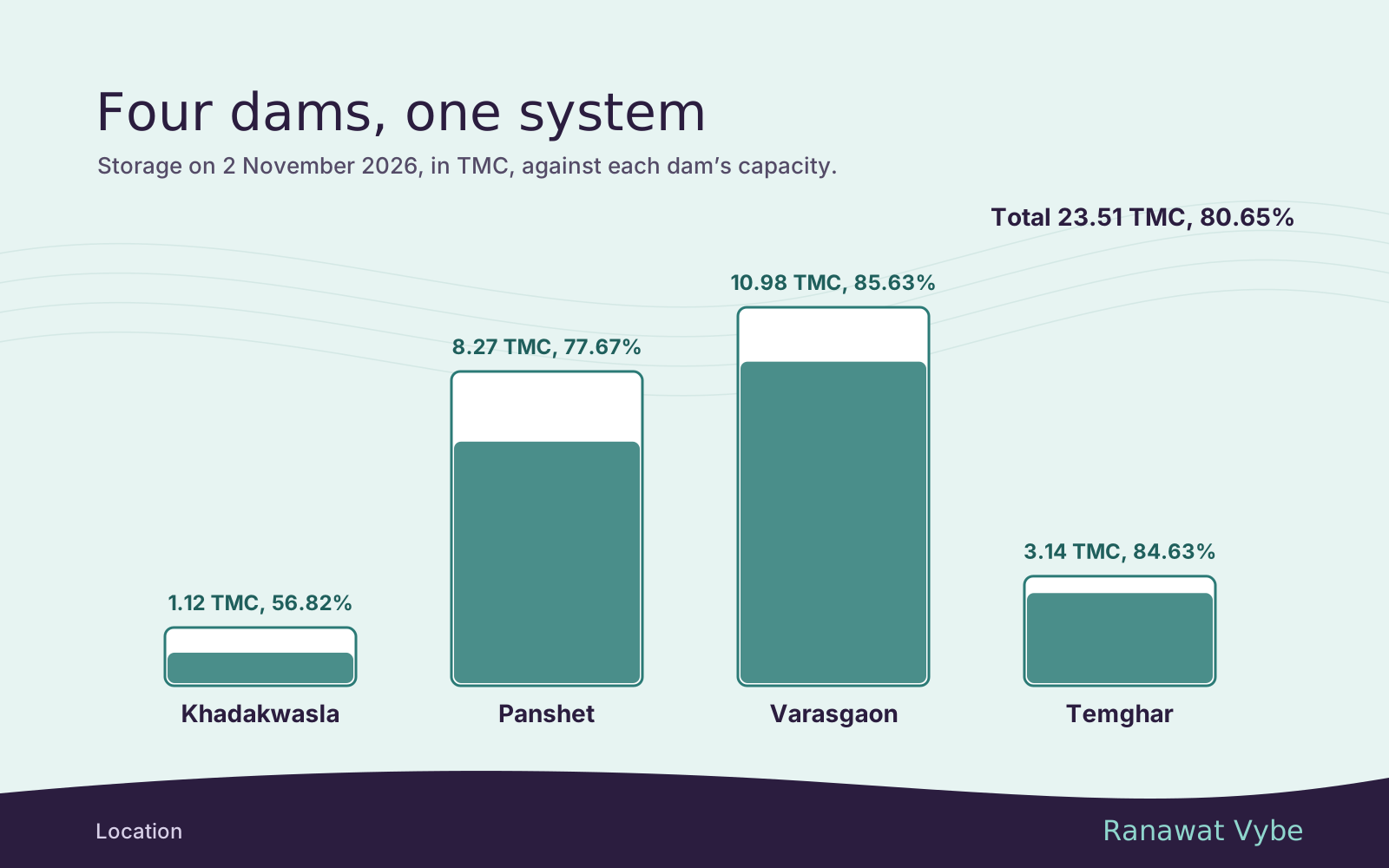
The PMC draws most of its water from the Khadakwasla system: four dams on the Mutha and its tributaries, namely Khadakwasla, Panshet, Varasgaon and Temghar. Together they hold about 29.15 TMC when full. Khadakwasla, at the far end of Sinhagad Road, is the smallest of the four; most of the water is held in the dams upstream.
| Dam | Storage on 2 November 2026 | Share of capacity |
|---|---|---|
| Khadakwasla | 1.12 TMC | 56.82% |
| Panshet | 8.27 TMC | 77.67% |
| Varasgaon | 10.98 TMC | 85.63% |
| Temghar | 3.14 TMC | 84.63% |
| Total | 23.51 TMC | 80.65% |
Those figures, from Punekar News on 2 November 2026, compare with 28.40 TMC (97.41%) on the same date a year earlier.
The harder number is the gap between what the city is allowed and what it uses. Punekar News reported in May 2026, from a written reply by the PMC’s water supply department, that the Water Resources Department had sanctioned a quota of 14.61 TMC against a requirement of 21.03 TMC, and that about 32% of the water supplied, roughly 7 TMC a year, is lost to leaks. In October 2026 the state asked local bodies to cut consumption by at least 10% from 16 October, and the PMC said it was preparing for a possible weekly shutdown, the Free Press Journal reported.
From the dam to the tap
Raw water is treated at PMC water works before it reaches the overhead tanks that feed each neighbourhood. One of them is at Vadgaon. Punekar News reported in May 2026 that a new overhead tank at Dhayari, built around 2017 and idle for years for want of pipelines, was in the final stage of being connected to the Wadgaon water works. Separately, the PMC proposed a 125 MLD treatment plant at Wadgaon Budruk under the Union government’s AMRUT 2.0 programme, to take over the Satara Road areas now served by the 50-year-old Parvati plant, Indian Infrastructure reported in December 2023. We could not confirm that plant’s current status.
The network is the weak link, not the source. The Free Press Journal reported in January 2026 that in Wadgaon Budruk and Dhayari only about a third of residents get regular municipal water, with the rest relying on tankers and borewells, even though these areas came into PMC limits more than 25 years ago.
The 24x7 equal water supply scheme
The PMC’s equal water supply scheme, announced in 2017, is meant to fix uneven distribution with new pipelines, storage tanks and meters. Its progress, as reported:
- January 2026: about 85% complete; 67 of 82 planned tanks finished; about 1,100 of 1,200 km of pipeline laid; officials aiming for May 2026 (The Bridge Chronicle).
- September 2026: nearly 88% of civil work done; trials to begin in about 60 of the city’s 144 distribution zones, with sample bills but no charges during the trial; about 2.75 lakh meters in the plan; some resistance to meters from residents (Free Press Journal).
Neither report lists which zones are in the first trials, so we cannot say whether any part of Vadgaon is among them. It is also worth being clear about what the scheme does. It changes how water is distributed and measured. It does not add water at the source, so the gap between the quota and the city’s demand remains. The PMC has not put it that way; it is our conclusion from the figures above.
Tankers, and how they show up in maintenance
PMC data reported by Punekar News in March 2026 counted 46,068 tanker trips in February 2026, against 39,488 in February 2025 and 33,951 in February 2024. Kirkatwadi, Vadgaon Budruk and Dhayari were among the areas named where tanker use had risen. The PMC runs a tanker filling point at Dhayari and supplies free tankers where its network is missing or inadequate.
Private tankers cost far more. Punekar News reported in June 2026 that 10,000-litre private tankers had risen from ₹800 to ₹1,000 to between ₹1,200 and ₹2,500 in many areas, with drinking-water tankers up to ₹3,000, against an official PMC tanker rate of about ₹666. In Dhayari and Vadgaon Khurd, wells that once filled 10 to 12 tankers a day were managing about five. One society representative elsewhere in the city told the paper that a major portion of their maintenance now goes on buying water. How that cost is split between flats is covered in the article on maintenance and the sinking fund.
What to ask a developer about water
None of this makes a building good or bad on its own. What matters is whether the developer has planned for it. Before you book anywhere on this corridor, ask:
- Has the PMC approved a water connection for the project? Ask to see the approval and the quantity it allows.
- Which water works and distribution zone will serve the site, and is that zone covered by the equal water supply scheme?
- What is the plan until municipal supply is regular? Borewells, tankers, or both, and who pays in the first years.
- How much storage is planned? Underground and overhead tank capacity, in days of the building’s use.
- Is there rainwater harvesting or treated water for flushing and gardens? Both reduce how much the society has to buy.
- Will each flat have its own water meter?
- What water cost is built into the estimated maintenance? A figure that assumes regular PMC supply will look different in a dry May.
For Codename Vybe, the developer has not yet published its water arrangements. The specification sheet covers plumbing inside the home, such as the provision for a purifier in the kitchen and for solar water heating in one bathroom, but not where the building’s water will come from. The location page covers the wider corridor.
If water supply is a deciding factor for you, send us your questions and we will pass them to the developer’s team and share the answers as they come.