Possession gives you a flat. It does not yet give the residents control of the building. Until a cooperative housing society is registered and the promoter conveys the building and land to it, the promoter still holds title to the common areas and, in most projects, runs the place. Two steps close that gap: forming the society and executing the conveyance.
This guide sets out the Maharashtra rules for both, and what residents can do if a promoter stalls. Codename Vybe is at pre-launch and has no MahaRERA registration yet, so nothing here describes its actual timetable.
When the society must be formed
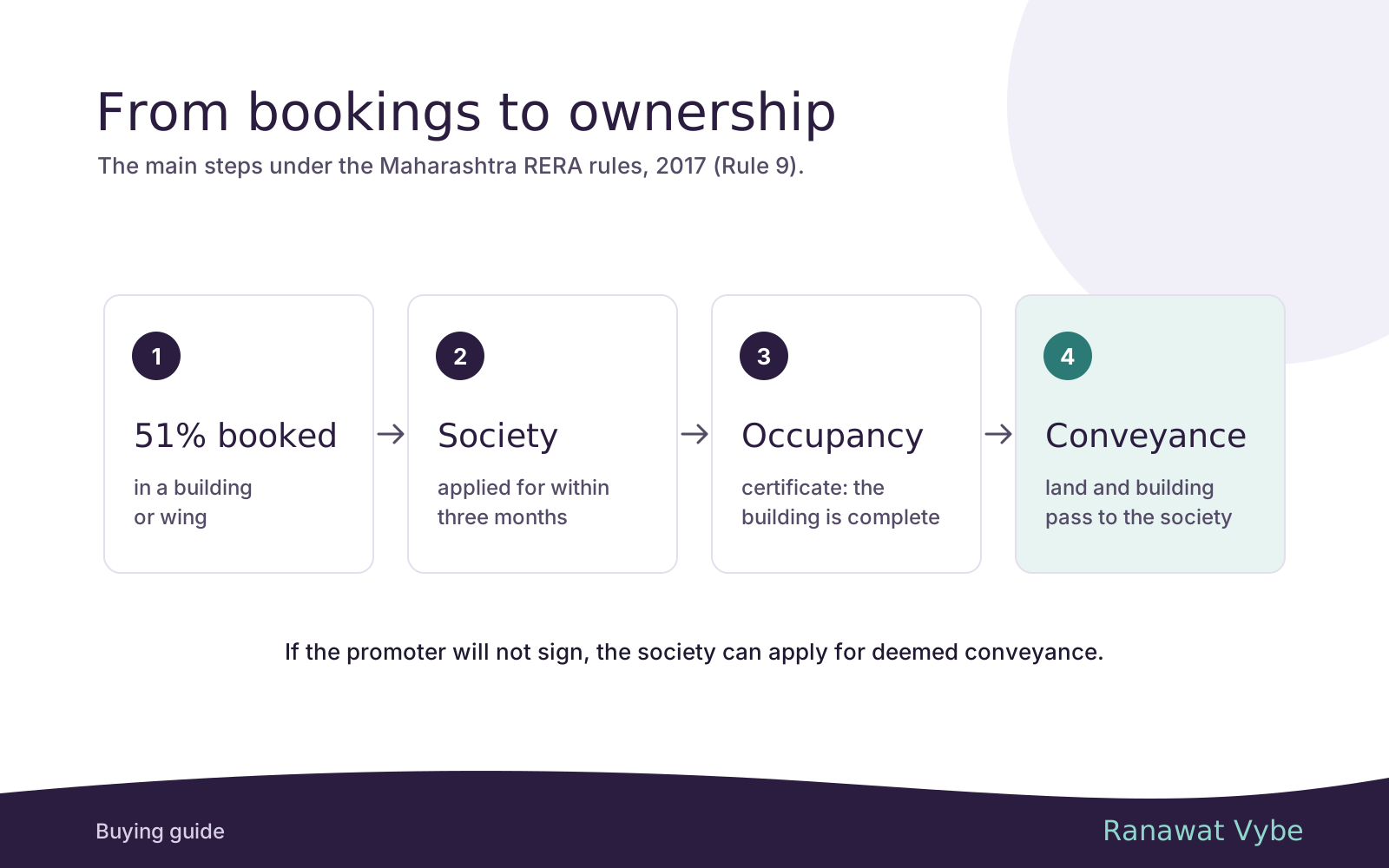
Section 11(4)(e) of the Real Estate (Regulation and Development) Act, 2016 makes the promoter responsible for enabling a society of allottees under the laws that apply, and Section 19(9) asks every allottee to take part. Maharashtra fills in the detail in Rule 9 of its RERA rules, notified in April 2017: the promoter must apply to the Registrar to register the society within three months from the date on which 51 per cent of the allottees in a building or wing have booked.
That trigger is about bookings, not completion. In a project that sells well during construction, the society can fall due long before anyone moves in. Where a layout has several buildings, Rule 9 adds an apex body, a federation of the building societies, which the promoter must apply for within three months of the occupancy certificate for the last building. If the promoter does not apply, MahaRERA can order it to, or authorise the allottees to apply themselves, and Section 61 of the Act allows a penalty of up to five per cent of the project’s estimated cost for breaching the Act or its rules.
The deadlines in one place
| Step | Deadline | Source |
|---|---|---|
| Apply to register the society for a building or wing | Within three months of 51 per cent of its allottees booking | Rule 9(1), Maharashtra RERA rules, 2017 |
| Apply to register the apex body for a multi-building layout | Within three months of the last building’s occupancy certificate | Rule 9(1) |
| Convey a single building to its society | As agreed; if no period is agreed, within three months of the occupancy certificate or of 51 per cent of allottees paying in full, whichever is earlier | Rule 9(2) |
| Convey a building in a layout (the structure, without basements and podiums) | Within one month of the society’s registration or three months of the occupancy certificate, whichever is earlier | Rule 9(2) |
| Convey the layout land to the apex body | Within three months of the apex body’s registration or of the last building’s occupancy certificate, whichever is earlier | Rule 9(2) |
| Hand over documents and plans, including those of the common areas | As local law requires; failing that, within 30 days of the occupancy certificate | Section 17(2) of the Act |
Conveyance, and why it matters
Conveyance is the registered transfer of the building, and eventually the land under it, from the promoter to the society. Your own registered agreement covers your flat. The conveyance gives the residents, collectively, title to everything else: the structure, the common areas and the plot. Without it, a society cannot easily deal with its own land, which matters most decades later, when the building needs repair on a large scale or redevelopment.
Where local law is silent, Section 17(1) of the central Act sets a fallback of three months from the occupancy certificate. Maharashtra’s older flats law, MOFA, sets its own period of four months from the formation of the society, and the law firm S&R Associates, writing for Chambers and Partners in June 2026, described years of jurisdictional uncertainty between the two laws. Read your agreement’s conveyance clause against Rule 9, and ask the promoter in writing which timetable it will follow.
Conveyance does not end the promoter’s duty to repair defects reported within five years of possession. The guide to defect liability covers how that works.
Deemed conveyance when the promoter will not sign
If a promoter does not convey, Rule 9 lets MahaRERA order it to, and lets the society obtain a unilateral deemed conveyance registered under MOFA. Promoters of RERA-registered projects had argued that the MOFA route did not reach them. According to the same Chambers and Partners article, the Maharashtra Ownership Flats (Amendment and Validation) Act, 2025, enacted on 31 December 2025, answered that by inserting Section 11A: where a promoter fails its conveyance duty under Section 17 of the central Act, the allottees or their association can apply to the District Deputy Registrar of Cooperative Societies, with retrospective effect from 1 May 2016.
The process has also moved online. Outlook Money reported in May 2025 that the state’s PRATYAY MahaBhumi portal handles deemed conveyance from application to certificate, with hearings mostly online and a six-month limit for the whole procedure. The same report said 78,116 of the state’s roughly 1.25 lakh cooperative housing societies lacked deemed conveyance, which shows how often this step is left undone.
What the society should receive
The handover is more than the keys to the clubhouse. Between the Act and the rules, the promoter owes the society:
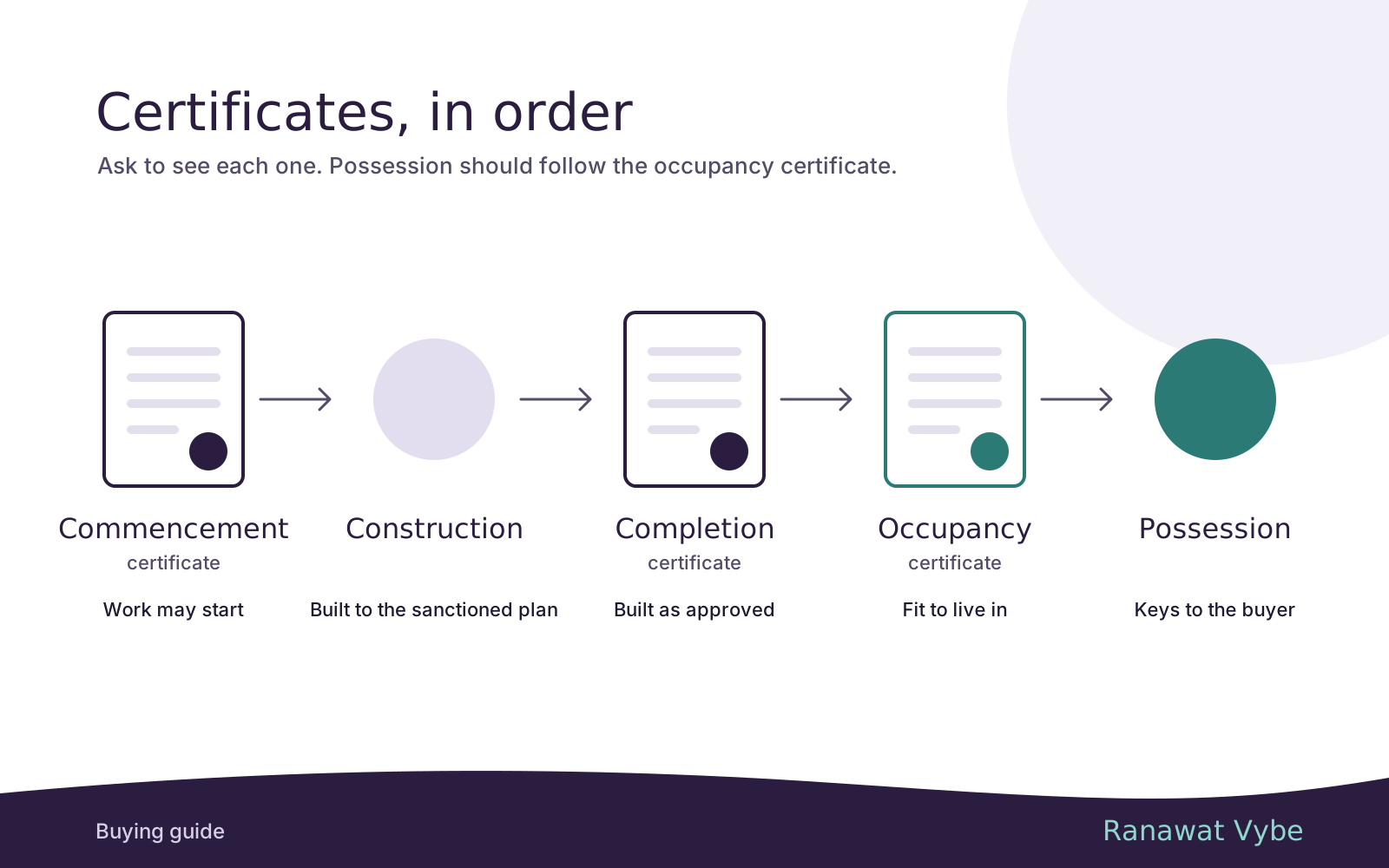
- the occupancy certificate or completion certificate, which Section 11(4)(b) says must be made available to the allottees or their association;
- the necessary documents and plans, including those for the common areas, under Section 17(2);
- the title documents that go with the conveyance, under Section 17(1);
- the documents for any insurance the promoter was required to take, under Section 16(4) and Rule 9(5).
Ask for more than the minimum. Under the state’s building regulations, which apply in PMC limits, the completion certificate filed by the supervising architect or engineer is accompanied by plans of the completed building, a lift operation certificate and a structural stability certificate, plus the fire officer’s NOC for buildings classed as special buildings. Copies belong in the society’s records, along with lift and equipment maintenance contracts and a full account of every deposit the promoter collected towards maintenance.
That last item is where handovers most often go wrong. Business Today reported in July 2025 on a Mumbai township buyer who had prepaid four years of maintenance, only to be billed again after the builder handed over the society without the payment records. The guide to maintenance and the sinking fund explains how those funds should be held.
What to ask about Codename Vybe
The developer’s drawings to date cover A Building only, as shown on the floor plans page. Whether the layout will hold more buildings, and so need an apex body, is a question for the developers once the project is registered. When the drafts are available, ask how many buildings and phases the layout will have, when the society application is planned, and whether the first conveyance will cover the land or only the structure. How the developers have handled society handovers in their earlier projects, listed on the developer page, is worth asking about too. This is general information, not legal advice.
You can send questions or register your interest through the contact page.